Einar Thorsen

Professor of Journalism and Communication at Bournemouth University

Publications | Conferences | Teaching | Projects

PGP Public Key
Finger print: 5568 022B F641 362E D18B BCCC 1FC5 CA72 FA67 FDF9
  • E-mail
  • Facebook
  • Instagram
  • LinkedIn
  • Phone
  • Pinterest
  • Tumblr
  • Twitter

Powered by Genesis

Three-D Issue 16, April 2011 – Higher Education Funding Cuts

4 April, 2011 by Einar Thorsen Leave a Comment

I have just published the April 2011 issue of Three-D, the MeCCSA’s newsletter. Hope you enjoy it – any questions or comments, please do let me know.

Three-D, issue 16 (PDF, 2.5 Mb) – LatestMeCCSA Three-D newsletter cover
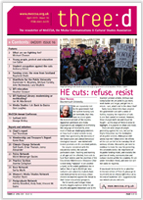
In this issue:
1 HE cuts: refuse, resist (Einar Thorsen)

Features
2 What are we fighting for? (Michael Chanan)
4 Young people, protest and education (Lee Salter)
7 Student occupation against the cuts (Anthony Killick)
9 Funding crisis: the view from Scotland (Raymond Boyle)
11 Manifesto for the Public University (Gurminder K. Bhambra, Michael Farrelly, John Holmwood, Lucy Mayblin)
12 BFI relocation (Heather Stewart)
12 BFI National Library: modernising or mothballing? (Ian W. Macdonald)
14 Media Studies 1.0: Back to Basics (Dan Laughey)

MeCCSA Annual Conference
17 Salford 2011 (George McKay)

Reports and initiatives
18 Chair’s report (Sue Thornham)
19 Membership and Treasurer’s Report (Karen Ross)
20 Climate Change Network (Neil Gavin, Einar Thorsen, Jenny Alexander)
23 Policy Network (Máire Messenger Davies)
24 Practice Section (Joanna Callaghan)
25 Race Network (Sarita Malik)
26 Women’s Media Studies Network (Heather Nunn)
27 Postgraduate Network (Ashley Woodfall, Andy Tedd, Vincent M. Gaine)

Filed Under: Blog, MeCCSA Tagged With: Andy Tedd, Anthony Killick, Ashley Woodfall, cuts, Dan Laughey, George McKay, Gurminder K. Bhambra, Heather Nunn, Heather Stewart, Ian W. Macdonald, Jenny Alexander, Joanna Callaghan, John Holmwood, Karen Ross, Lee Salter, Lucy Mayblin, Máire Messenger Davies, meccsa, Michael Chanan, Michael Farrelly, Neil Gavin, Raymond Boyle, Sarita Malik, Sue Thornham, three-d, Vincent M. Gaine

Student Wiki Pages: reflecting on new e-learning strategy for collaborative student notes

29 March, 2011 by Einar Thorsen Leave a Comment

Below are parts of a formal report I have written about my experience of using wiki tools as part of a wider e-learning strategy. You can read about the background to the experiment in part 1 and part 2 of this series.

Summative assessment component (30%) for Communication Skills, Level C unit on BA (Hons) Communication and Media, BA (Hons) English.

Pedagogic aim was to assess students’ ability to working effectively in a computer-mediated environment by applying interpersonal communication skills taught in the unit, in addition to fostering a professional engagement with the unit’s theoretical foundation.

Each of the seven seminar groups had a dedicated wiki section on myBU, which students used for collaboratively producing notes from the weekly lectures and set readings. Comments were used to discuss the lecture and readings with fellow students, as well as strategies for formulating the joint text.

Students were required to contribute to 8 out of 10 lecture weeks. Each student’s contribution was evaluated quantitatively (proportion of text written, number of edits, number of weeks participating) and qualitatively (accuracy, detail and self-reflexivity of final entries).

Evidence of impact
The Student Wiki Pages was an integral part in inspiring students’ commitment to learning on this unit, evidenced by:

1. Ensuring good attendance at lectures and professional attitude to learning

  • The requirement for each student to contribute to a set number of weeks, meant attendance at lectures was essential.
  • Attendance was regularly above 80%, despite being held at Lansdowne campus due to building works at Talbot campus.

2. Inspired student understanding of scholarly literature and engagement in lectures

  • Students developed a competitive spirit about who could be the first to contribute and who would write the most each week. They came prepared and were confident in their contribution to discussion during lectures.
  • Typically around 15% of students even contributed directly to their wiki during the lectures, using laptops or iPads to write and mobile phones to take pictures / record audio.

3. Facilitated electronic peer support and discussion groups

  • Students used the wiki to support each other’s learning by using the collaborative text for revision, asking questions, and discussing lectures and readings.

4. Improved engagement with scholarly literature in both summative assessment components

  • Weekly wiki entries were frequently around 10,000 words, often with 10-15 comments discussing relevant topics – both far exceeding expectation.
  • The quality of the second assignment, an extended essays, was noticeably improved compared to 2009/10. In particular students had a much more solid grasp of conceptual vocabulary and in-depth engagement with a wider range of scholarly literature.

5. Increased grade average for students taking unit

  • The overall grade distribution was significantly improved, including 13 firsts compared to none in 2009/10.

Feedback from a student retaking unit, with experience of wiki pages as both formative and summative assessment:

I also want to say how good an idea it has been to mark the wiki pages. Last year they were up and I paid no real heed to them, as they didn’t affect my grade. However this year they’ve made sure everyone turns up to lectures (which I and others didn’t last year) and will also be an integral part of the bigger assignment. This has also increased my understanding of the unit as I’ve had to do the further reading, which I clearly didn’t last year.

Transferable learning
The Student Wiki Pages assessment encouraged students to develop active learning techniques and scholarship at the start of their degree programmes, providing a solid underpinning for their future studies. Collaboratively producing notes meant students had to be proactive and critically evaluate their own notes from the lecture and the set readings on a weekly basis. This contrasts with a passive form of study, where students superficially read only a selection of the required material, often towards the end of the unit.

Whilst part of this assessment was subject specific, i.e. facilitating students’ experimentation with computer-mediated communication in the context of the theoretical foundation of the Communication Skills unit, this was not integral to the pedagogical benefits of using wiki tools as outlined above. The Student Wiki Pages could form part of any e-learning strategy that complements a series of lectures, seminars or workshops to enhance the overall student experience.

Part 4: I will follow up this post with some more in-depth reflections soon, specifically about how to manage the complexity of this type of assignment (relating to both setting student expectations, reassuring them about ongoing performance, and managing marking).

Update 5th May 2011: Yesterday I received the Vice Chancellor’s Educational Innovation of the Year Award at Bournemouth University for this project. More on the award in Part 4 of this series. Thanks to all the students who took part in the experiment!

Filed Under: Blog, Teaching Tagged With: assessment, bacom, bae, communicationskills, e-learning, education, studentwikipages, teaching, wiki

Mediating Environmental Change: Exploring the Way Forward

25 February, 2011 by Einar Thorsen Leave a Comment

Please note that there are still some places left for the MeCCSA Climate Change, Environment and Sustainability Network’s symposium “Mediating Environmental Change: Exploring the Way Forward”, held at Bournemouth University Friday next week.

The event is scheduled to run from 09:00 – 18:30, 4th March 2011.

The programme is available online and contains links to abstract for all papers.

The symposium will debate emerging and established forms and practices of environmental communication, including:

  • Global Issues and Local Contexts
  • Climate Activism and Citizen Conversations
  • The Power of Mediation
  • Conservation, Media and Pedagogy

Speakers include:
James Painter (University of Oxford / formerly BBC World Service)
Rupert Read (University of East Anglia / The Green Party)
Adrian Newton (Bournemouth University / formerly the United Nations Environmental Programme)
Dan Glass (Plane Stupid)
Alex Lockwood (University of Sunderland / Save Our Forests)
Julie Doyle (University of Brighton)
Michael Goodman (King’s College London)

…plus an exciting array of speakers from universities across the UK and overseas.

If you wish to attend, please register using our online system.

The symposium fee is £25 for all delegates. Vegetarian buffet lunch and refreshments will be provided.

Our website has information on travel to Bournemouth and accommodation.

If you have any other questions, please do not hesitate to get in touch.

We look forward to welcoming you in Bournemouth on 4th March!

All the best,
Einar Thorsen and Jenny Alexander
Conference Organising Committee

Filed Under: Blog, Environment, Events, Mediating Environmental Change: Exploring The Way Forward

‘There was never an average day’: James Ball on being WikiLeaks’ in-house journalist

31 January, 2011 by Einar Thorsen Leave a Comment

James Ball on being WikiLeaks’ in-house journalist:

What I think gets forgotten is that five of the world’s biggest newspapers – and WikiLeaks – held a shared timetable for three weeks. That’s an unprecedented level of collaboration, and I think everyone involved will look back on it more favourably than perhaps they do at the moment.

While I think the duty exists to an extent, WikiLeaks wants to be seen by media outlets as a partner organisation, receiving due credit as the source of the material, being free to release its own stories and take on the subject matter, and to co-publish. I think that’s a more activist and more controlling position than a typical source, and so perhaps means outlets have less duty of care than otherwise.

WikiLeaks is a conduit which exists to protect the people who are directly taking the risks to get powerful material to the public. They are the sources that most deserve, and need, protection.

Filed Under: Blog, Journalism

Books on WikiLeaks

31 January, 2011 by Einar Thorsen Leave a Comment

The Guardian has published a book on WikiLeaks today, with The New York Times and Der Speigel also presenting their version of events in book format – perhaps they’re all just trying to get in before Julian Assange publishes his chronicle?

I will update this post with order details and other books as they become available. If you come across any that are not listed, please do let me know.

The Guardian:
Wikileaks, by David Leigh & Luke Harding, £6.99

Inside Wikileaks, by Daniel Domscheit-Berg, £7.99

WikiLeaks Versus the World [Hardback], by Julian Assange, £16.00

The New York Times:
Open Secrets: Wikileaks, War and American Diplomacy [ebook], by Alexander Star (ed) Bill Keller (intro), £4.30

Der Spiegel:
WikiLeaks: Public Enemy No. 1, by Marcel Rosenbach and Holger Stark [not found link to translated version yet]

Bloggers:
The Age of Wikileaks: From Collateral Murder to Cablegate (and Beyond), By Greg Mitchell, £7.61

Filed Under: Blog, Citizen Journalism, Journalism Tagged With: Bill Keller, David Leigh, Der Spiegel, Greg Mitchell, guardian, Holger Stark, Julian Assange, Luke Harding, Marcel Rosenbach, New York Times, NYT, Wikileaks

  • « Previous Page
  • 1
  • 2
  • 3
  • 4
  • 5
  • …
  • 74
  • Next Page »