Einar Thorsen

Professor of Journalism and Communication at Bournemouth University

Publications | Conferences | Teaching | Projects

PGP Public Key
Finger print: 5568 022B F641 362E D18B BCCC 1FC5 CA72 FA67 FDF9
  • E-mail
  • Facebook
  • Instagram
  • LinkedIn
  • Phone
  • Pinterest
  • Tumblr
  • Twitter

Powered by Genesis

Why Twitter matters for media organisations

19 November, 2010 by Einar Thorsen Leave a Comment

Alan Rusbridger claims saying that Twitter has got nothing to do with the news business is about as misguided as you could be and explains why Twitter matters for media organisations:

1. It’s an amazing form of distribution
2. It’s where things happen first
3. As a search engine, it rivals Google
4. It’s a formidable aggregation tool
5. It’s a great reporting tool
6. It’s a fantastic form of marketing
7. It’s a series of common conversations. Or it can be
8. It’s more diverse
9. It changes the tone of writing
10. It’s a level playing field
11. It has different news values
12. It has a long attention span
13. It creates communities
14. It changes notions of authority
15. It is an agent of change

Well worth a read for how he explains each point in turn, and then concludes that:

Increasingly, social media will challenge conventional politics and, for instance, the laws relating to expression and speech. […] we can be sure that the motivating idea behind these forms of open media isn’t going away and that, if we are blind to their capabilities, we will be making a very serious mistake, both in terms of our journalism and the economics of our business.
Filed Under: Blog, Journalism, Links Tagged With: alanrusbridger, futureofjournalism, guardian, news, twitter

Amazing Datajournalism Tool: Build Your Own International Human Development Index

5 November, 2010 by Einar Thorsen Leave a Comment

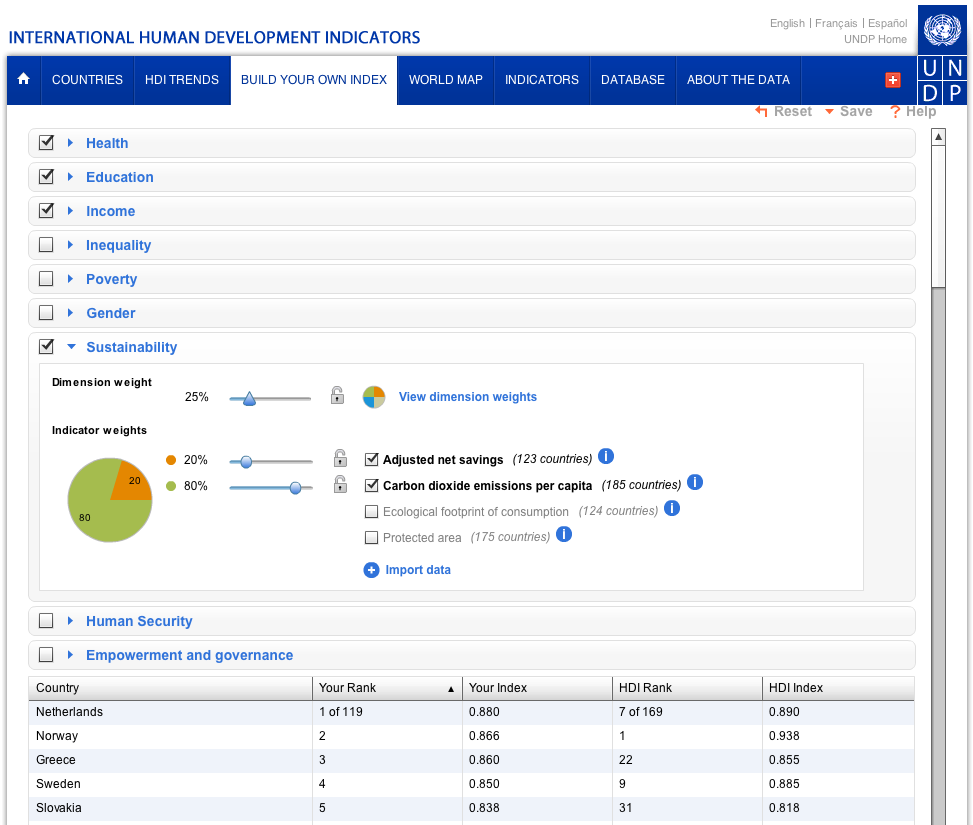
Be sure to check out this amazing new website from the UN that allows you to build your own International Human Development Index by dynamically changing the criteria used. Incredibly the website also allows you to upload your own data sets for inclusion in the index, or download the official ones in spreadsheet format for analysis or custom mashups.

The UN recently released its Human Development Report 2010 (20th Anniversary Edition), entitled The Real Wealth of Nations: Pathways to Human Development. Drawing on a phenomenal range of statistics, the index is intended to to stimulate global, regional and national policy discussions on issues that are relevant to human development.

Courtesy of Vox Publica.

Filed Under: Blog, Journalism Tagged With: civicmedia, datajournalism, hdi, mashup, un, undp

Science Journalism in a Digital Age – Call for Papers

27 August, 2010 by Einar Thorsen Leave a Comment

Journalism: Theory, Practice and CriticismSPECIAL ISSUE OF JOURNALISM: THEORY, PRACTICE AND CRITICISM

Guest Editor: Stuart Allan, Bournemouth University, UK

In taking science journalism as its focus, this special issue of Journalism will seek to contribute to current debates about the ways in which this important genre of reporting is being transformed by the changes ushered in by digital media.

Today it is readily apparent that precisely what counts as ‘science news’ is undergoing dramatic redefinition as the convergence of ‘old’ and ‘new’ media continues apace. The challenges facing the science journalist have always been formidable, of course, but the internet and associated digital technologies are bringing to bear new pressures and constraints – as well as creating fresh opportunities for innovation – deserving of our close attention. While the very future of science journalism is being called into question by some, others point to alternative approaches to science reporting that are flourishing online.

In exploring these concerns, this special issue’s agenda is informed by a sense of urgency. At a time when many news organizations are under intense financial pressure to trim or reduce expenditure on specialist, investigative reporting, it is all too often the case that science news is regarded as expendable. In the eyes of some, it is a luxury increasingly difficult to justify when other types of news will be more popular with audiences (and thus advertisers). CNN’s decision to cut its entire science, technology and environment news staff, for example, provoked widespread alarm when it was announced in 2008. Few commentators failed to note the irony that science issues – such as climate change, stem cell research, evolution and bio-terrorism – were proving sufficiently controversial to attract intense news coverage at the time.

Accordingly, a guiding theme of the special issue is that current assessments of the news media’s public responsibilities in a democracy can be enriched by inquiries into the changing nature of science journalism. Possible topics to be examined may include:

  • The political economy of science journalism
  • Journalists’ uses of digital technologies in science reporting
  • Rethinking the news values of science coverage
  • Scientists as news sources and the politics of expertise
  • The framing of controversy in science stories
  • The impact of blogging on science news
  • Audience perceptions of science news on the web
  • Science journalism and social networking

Prospective authors should submit an abstract of approximately 250 words by email to Stuart Allan (sallan@bournemouth.ac.uk). A selection of authors will be invited to submit a full paper according to the journal’s Notes for Contributors. Acceptance of the abstract does not guarantee publication, given that all papers will be subjected to peer review.

Timeline

Deadline for abstracts: 1 October, 2010; deadline for submission of articles: 31 December, 2010. Final revised papers due: March, 2011. Publication: Volume 12, No. 7

About Editor

Stuart Allan’s science-related publications include Environmental Risks and the Media (co-edited, 2000), Media, Risk and Science (2002), and Nanotechnology, Risk and Communication (co-authored, 2009). Recent co-written journal articles have appeared in New Genetics and Society (2005), Science Communication (2005), Health, Risk & Society (2007), Public Understanding of Science (2009), and Journal of Risk Research (2010).

Professor Stuart Allan
The Media School
Bournemouth University
Talbot Campus
Poole, Dorset
BH12 5BB
UK

sallan@bournemouth.ac.uk

Filed Under: Blog, Call for papers, Journalism Tagged With: cfp, journal, Journalism, news, sciencejournalism, stuartallan

Online Reporting of Elections – call for papers

7 July, 2010 by Einar Thorsen Leave a Comment

Journal of Journalism PracticeJOURNALISM PRACTICE
SPECIAL ISSUE CALL FOR PAPERS

Guest editor: Einar Thorsen

Elections represent a great spectacle of journalism and are therefore ideally suited to reflect upon the current and future state of journalism practice in relation to online political news and communication.

Online news reporting in its various guises is now an essential part of online political journalism. Recent examples range from political blogging and Youtube debates during the 2008 US presidential election, through the use of Twitter to report and mobilise civic uprising in the aftermath of the 2009 Iranian and Moldovan elections, to the normalising of online news during the 2010 UK general election.

Newspapers and broadcasters now invest heavily in election micro-websites. Journalists increasingly use Twitter and Facebook for breaking news or unconfirmed rumours, and also as a valuable source of ‘public sentiment’ and insight into the political process. Ordinary citizens, for their part, use social media to hold politicians and mainstream media to account.

This special edition of Journalism Practice will be an opportunity to discuss the role of online news reporting during national elections and referendums. It will provide a forum for both practitioners and academics to discuss emerging and established forms and practices of online journalism.

Comparative research is of particular interest to this special edition – either different national contexts, or different news practices within the same national context.

Suggested areas of focus include, but are not limited to:

  • How does online election reporting compare across different national contexts?
  • Has online journalism lived up to expectations during elections?
  • How has the Internet changed the working practices of political journalists?
  • How does online reporting of elections compare to print and broadcasting?
  • What role have citizen journalists had in the media landscape during elections?
  • How have Twitter and Facebook influenced the way journalists connect with audiences?
  • How do journalists use social media, blogs and UGC as election news sources?
  • What are the strengths and limitations of live blogging?
  • How have the features of online news impacted on election campaigns?
  • How have news organisations facilitated online public debates and comment?
  • How has online journalism helped inform electorates?

Prospective authors should email abstracts of 500 words to Einar Thorsen (ethorsen@bournemouth.ac.uk). Papers will then be invited and subject to peer review.

  • Deadline for submission of abstracts: 10 September 2010
  • Deadline for submission of articles for review: 1 December 2010
  • Final revised papers due: 31 March 2011 (following peer review)
  • Publication: end of 2011/early 2012

If you have any questions or want to discuss an idea for the special issue, please do not hesitate to get in touch.

PDF version of CfP available on Routledge website.

Filed Under: Blog, Call for papers, Journalism Tagged With: cfp, elections, journal, journalismpractice, onlinereporting

Expression of interest:
Online Reporting of the 2010 UK Election Symposium

19 May, 2010 by Einar Thorsen Leave a Comment

Filed Under: Blog, Events, Journalism Tagged With: conference, election2010, elections, onlinejournalism

  • « Previous Page
  • 1
  • 2
  • 3
  • Next Page »